
The Gut-BMS Connection
Is Your Gut Talking to Your Mouth?
What do we know about Burning Mouth Syndrome and the digestive system?
If you have burning mouth syndrome (BMS), you’ve probably had your thyroid checked, your vitamin levels drawn, maybe even a biopsy or two.
But has anyone asked about your digestion?
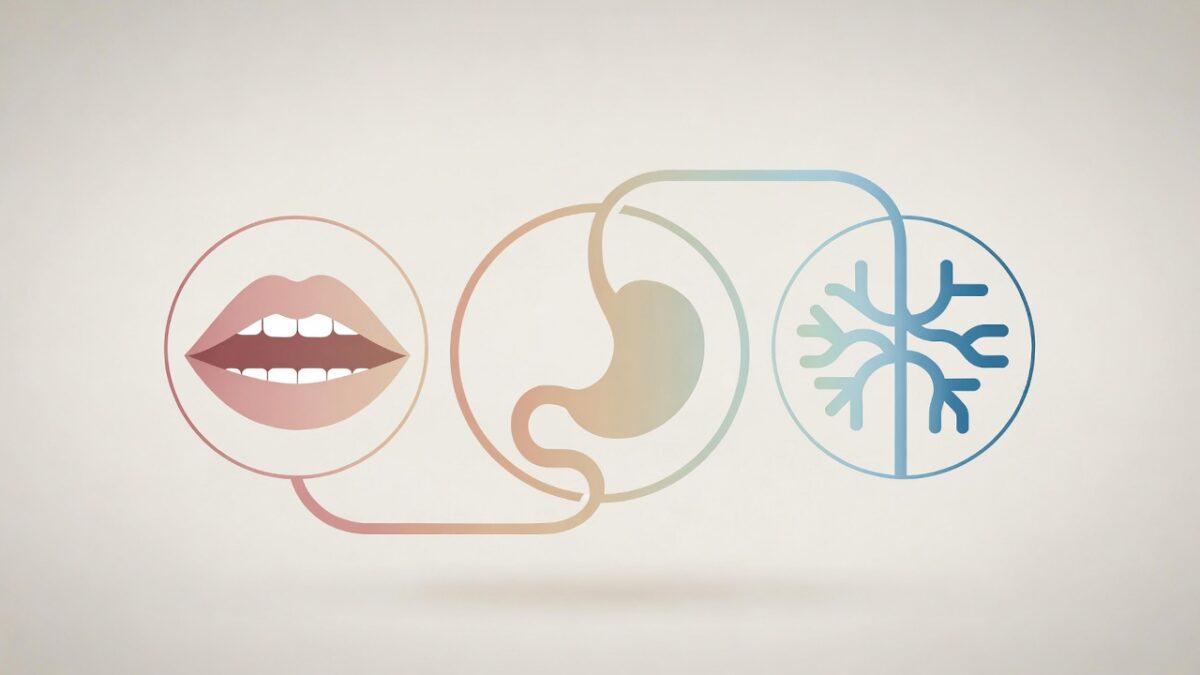
It’s a reasonable question. The mouth is the beginning of the gastrointestinal tract, not a separate system that happens to sit nearby. While not enough research is being done about burning mouth syndrome specifically, a growing body of research is looking at how the gut and the nervous system talk to each other, with real implications for chronic pain conditions. Here’s what’s actually been shown, and what’s still an open question.
The Clearest Gut-BMS Connection Is Acid Reflux You Might Not Even Feel
The best-established link between BMS and the digestive tract isn’t surprising. It’s reflux. Specifically, gastroesophageal reflux disease (GERD) and its cousin, laryngopharyngeal reflux (LPR).
But what may surprise you is that you can have reflux and not even feel it.
The prevalence of gastroesophageal reflux disease (GERD) is anywhere from 3-23% for burning mouth patients. This is the one you’ve heard of, the one you can usually feel as that characteristic heartburn in your chest.
But far more BMS patients, 50%–94%, actually have laryngopharyngeal (the back of your throat and voice box) reflux, and LPR is sometimes called “silent reflux” because it doesn’t always come with the classic heartburn people associate with GERD. Instead, small amounts of stomach acid (and digestive enzymes like pepsin) travel up past the esophagus and reach the throat, larynx, and mouth — tissue that isn’t built to tolerate acid exposure the way the stomach lining is. The result can be a chronic sore throat, hoarseness, a sensation of a lump in the throat, chronic cough — and burning or altered sensation in the mouth and tongue.
This matters for two reasons. First, LPR can directly irritate oral tissue. It may mimic BMS symptoms in those who don’t have BMS, or it may worsen BMS symptoms in those who do have BMS.
This is why it’s worth ruling out (or treating) before settling on a diagnosis of primary BMS. Second, because LPR is often silent, it’s easy to miss — you don’t need to feel classic heartburn for it to be happening.
If you haven’t been asked about reflux symptoms, snoring, post-nasal drip, or a chronically raspy voice, it’s reasonable to bring it up with your provider.
A Second Gut-BMS Connection: Oral Bacteria
Separate from reflux, researchers have also studied the oral microbiome—the community of bacteria that normally lives on your tongue, gums, and salivary glands—in people with BMS. Several small studies comparing saliva from BMS patients to healthy volunteers have found differences in which bacterial species are present and in what proportions, a pattern sometimes called dysbiosis. Some of this research has also explored whether specific probiotic strains (certain lactic acid bacteria) might help restore balance and ease symptoms.
It’s important to be honest about where this evidence stands: these are mostly small, associative studies. They show that the oral microbiome in BMS looks different — they don’t yet prove that the different microbiome is causing the burning sensation, or that probiotics reliably fix it. It’s a promising, active area of future research rather than a settled answer.
The Bigger, Less-Charted Territory: Neuropathic Pain And The Gut-Brain Axis
Here’s where things get more interesting — and more speculative. BMS is increasingly understood as a form of neuropathic pain, meaning the pain arises from the nerves themselves misfiring or becoming overly sensitive, rather than from damage you can see. Small-fiber neuropathy affecting the tiny nerve endings in the tongue has been documented in a meaningful subset of BMS patients.
Separate from BMS specifically, there’s now a substantial body of research on how the gut talks to the nervous system in neuropathic pain conditions more broadly — things like diabetic neuropathy, chemotherapy-induced nerve pain, and nerve injury pain. This research hasn’t been done in BMS yet, but it’s worth understanding, because it may point toward where BMS research is headed.
A few things this research has established about the gut-nervous system relationship in general:
The gut and nervous system are in constant two-way conversation. This happens through several channels: the vagus nerve (a direct physical connection between the gut and brain), immune signaling chemical molecules, and metabolites produced by gut bacteria.
Gut bacteria produce substances that directly affect nerve activity. Short-chain fatty acids (byproducts of bacteria fermenting fiber), along with compounds like GABA and BDNF, can act as calming, “analgesic” signals to the nervous system when gut bacteria are in healthy balance.
When that balance is disrupted, the opposite can happen. An imbalanced gut microbiome (dysbiosis) has been linked to increased inflammation and to sensitization — a state where nerves become more reactive and pain signals get amplified, both in the peripheral nerves and in the central nervous system itself. This sensitization process is thought to be central to how neuropathic pain develops and persists.
Early interventions aimed at the gut have shown some promise in other neuropathic pain conditions besides BMS, including probiotics, dietary changes, and, in research settings, fecal microbiota transplantation, though the researchers doing this work are careful to note that human clinical trials are still limited and the science is young.
None of this has been specifically tested in burning mouth syndrome. But given that BMS shares the underlying mechanism — nerve sensitization — with the neuropathic pain conditions where gut-nervous system research has been done, it’s a reasonable hypothesis that the same biology could be relevant.
What the gut-BMS connection means for you, practically
You don’t need to overhaul your gut microbiome to manage BMS, and there’s no probiotic or elimination diet currently backed by strong evidence specifically for this condition. But a few things are worth doing:
- Get reflux genuinely ruled in or out. If you have any reflux symptoms — even mild or “silent” ones like a raspy voice or chronic throat clearing — it’s worth a real evaluation, since treating LPR can meaningfully improve oral burning in some patients.
- Pay attention to your own digestive health as part of the whole picture. Chronic GI symptoms, prior antibiotic courses, or a history of gut issues are all reasonable things to mention to a provider who’s working through your case, even if the research connecting them to BMS specifically isn’t fully mapped out yet.
- Hold the emerging research loosely. The gut-nervous system connection is real and increasingly well-documented for neuropathic pain in general. Its exact role in BMS is still being worked out. That’s not a reason to ignore it — but it’s also not yet a treatment plan.
BMS is a condition where the path to answers has often been “no one looked closely enough.” The gut looks to be one more place worth looking.
Download Dr. Sklar’s Free Ebook


Hope for Burning Mouth, the world’s first and only online course for sufferers of Burning Mouth Syndrome is now available. It was created by specialist Dr. Susan Sklar and based on her actual experience with Burning Mouth patients.
What You Will Get In The Course
- Lifetime access to your course portal
- A Virtual “Tool Kit” covering all aspects of Burning Mouth Syndrome
- Course work developed by a Burning Mouth specialist
- Seven Modules
- Sixty-two Lessons
- Self-Assessments
- Quizzes
- Homework
- 15% Discount on BMS Advanced Support
- An additional future module on new treatments for Burning Mouth Syndrome