
Top 5 Supplements for Burning Mouth Syndrome
Burning mouth syndrome (BMS) is a chronic pain condition that causes a persistent burning, scalding, or raw sensation in the mouth — without any visible wound or positive test result to explain it. It affects mostly women in midlife, clustering unmistakably around the menopausal transition, and remains one of the most under-treated conditions in medicine.
While no single approved cure exists, a growing body of research points to supplements that address the biological mechanisms driving BMS: nerve fiber damage, nutritional deficiencies, oxidative stress, hormonal decline, and nervous system sensitization. This guide covers the five most evidence-supported options — including two that work specifically on the hormonal side of the condition.
Please note: these supplements are not a replacement for medical care. Always discuss new supplements with your doctor or pharmacist, especially if you take prescription medications or have underlying health conditions.
1. Alpha-Lipoic Acid (ALA)
The most researched supplement specifically for BMS
Alpha-lipoic acid is a naturally occurring antioxidant the body makes in tiny amounts—but not nearly enough to fight the oxidative stress involved in BMS. What makes ALA special is that it is active in both water-based and fat-based environments, which means it can reach virtually every tissue in the body, including the delicate nerve fibers lining the tongue and oral mucosa.
BMS involves damage and misfiring of these small nerve fibers. Oxidative stress — essentially a build-up of damaging molecules called free radicals — is one of the main drivers of this nerve damage. ALA directly scavenges these free radicals, helps regenerate other antioxidants (including vitamins C and E), and has neuroprotective effects that support nerve repair. It is already used clinically for diabetic neuropathy, another small-fiber condition, which gives it strong biological plausibility for BMS.
What the research shows: A 2023 systematic review of randomized controlled trials concluded that ALA meaningfully reduces BMS burning. In one double-blind placebo-controlled trial, 64% of patients taking 600 mg/day reported improvement, compared to 27.6% in the placebo group — and about 69% maintained that improvement a month after stopping.
Best for — Primary BMS with neuropathic burning; more effective earlier in the condition
When to expect results — Most studies assessed outcomes at 2 months; some notice improvement within 4–8 weeks
Note on form — Look for R-ALA (R-alpha-lipoic acid) — the biologically active form; some products are a mix of R and S forms
Side effects — Generally well tolerated; occasional stomach upset at higher doses
2. B Vitamins (B1, B2, B6, B12, and Folate)
Essential nerve vitamins — and among the most common deficiencies in BMS
The B vitamins are the building blocks of a healthy nervous system. B1, B2, and B6 are essential for producing myelin — the protective sheath around nerve fibers. Without enough myelin, nerves become vulnerable, slow, and prone to misfiring. B12 and folate are required for nerve sheath formation and DNA synthesis; deficiency in either causes a type of nerve damage that, in the mouth, produces exactly the burning, tingling, and taste disturbance characteristic of BMS.
Studies consistently show that people with BMS have lower B vitamin levels than those without the condition. Correcting a B vitamin deficiency doesn’t just slow the decline—in many patients, it actively reverses the burning. B12 deficiency is particularly worth checking: it is common in women over 50 (due to age-related reduction in stomach acid needed to absorb B12), can exist even when blood levels look “normal” on standard tests, and is worsened by common medications including PPIs (proton pump inhibitors) used for acid reflux and metformin used to treat diabetes.
What the research shows: A clinical study of 89 BMS patients found that B vitamin complex plus zinc supplementation produced statistically significant reductions in pain and burning, as measured on a validated pain scale.
Best for — BMS with confirmed or suspected B12/folate deficiency; atrophic (smooth, red) tongue which can happen with vitamin B deficiency; patients on PPIs or metformin
When to expect results — Improvement in 4–12 weeks for deficient patients; oral tissue recovery may take longer
Test first — Ask your doctor to check serum B12, folate, and ideally homocysteine (a sensitive marker of functional B12/folate insufficiency)
B12 absorption issues — If severely deficient, your doctor may recommend B12 injections, which bypass gut absorption problems entirely
3. DHEA (Dehydroepiandrosterone)
Hormone Supplement — A prohormone that declines with age and may play a role in nerve pain and immune regulation
DHEA is a steroid hormone produced primarily by the adrenal glands. It is the most abundant circulating hormone in the human body — and one of the most dramatic casualties of aging. Levels begin falling in the late 20s and drop by around 80% by the time a woman reaches menopause. DHEA is a prohormone — a precursor that the body converts into a wide range of other hormones, including estrogen, testosterone, and neurosteroids. Not only does it have important actions of its own, but DHEA also helps the body to make what it needs, when and where it needs it.
Its relevance to BMS works through several pathways. First, DHEA has anti-inflammatory properties — it suppresses pro-inflammatory cytokines (chemicals) and modulates immune activity, which may reduce the neuroinflammation contributing to oral burning. Second, DHEA can be converted locally in oral tissues into estrogens, which maintain mucosal integrity, support salivary function, and protect the trigeminal nerve fibers that process sensation in the mouth. Third, research published in the Journal of Neuroscience in 2023 showed that DHEA-S (the sulfated form) is an internal modulator of Kv7 potassium channels—channels that regulate how easily nerve cells fire. DHEA-S reduced inflammatory pain responses in animal models by damping down nerve excitability, thus decreasing pain.
DHEA has shown benefit in Sjögren’s syndrome—an autoimmune condition that also causes severe dry mouth and oral burning—where a systematic review found decreased dry mouth symptoms with DHEA supplementation. This is directly relevant because Sjögren’s and BMS overlap clinically, and the mechanisms (mucosal atrophy or thinning, reduced salivary function, neuroinflammation) are similar.
“DHEA levels decrease dramatically with age and menopause. As a prohormone, it allows tissues to produce the hormones they need locally — including in the oral mucosa and the trigeminal nerve system.”
Best for — Postmenopausal women with BMS; those who cannot or prefer not to use HRT; women with dry mouth and mucosal atrophy alongside BMS; patients with low DHEA-S on blood testing
When to expect results — Hormonal effects accumulate over weeks to months; allow 3–6 months for full assessment
Test first — Ask for DHEA-S (the sulfated form, which is stable in blood) before starting
Hormone-sensitive conditions — DHEA may not be recommended for people with hormone-sensitive cancers (breast, ovarian, uterine) or those with a strong family history. Discuss with your doctor
Prescription vs over-the-counter — DHEA is available over the counter in the US but prescription-only in some countries, including the UK and Australia. Availability and regulation vary
Supervise with a professional — Because DHEA influences the hormonal cascade, it is strongly recommended to take it under medical supervision with periodic blood level monitoring
4. Pregnenolone
Hormone Supplement — The master neurosteroid precursor for pain modulation, anxiety, and nerve health
Pregnenolone sits at the very top of the hormonal cascade. It is synthesized from cholesterol in the adrenal glands, gonads, and, perhaps most importantly, in the brain and nervous system. It is the starting molecule from which the body makes virtually all other steroid hormones — including DHEA, estrogen, progesterone, testosterone, and cortisol. It is also one of the most abundant neurosteroids in the brain, where it acts as more than a precursor: it directly modulates nerve cell activity.
For BMS specifically, pregnenolone is relevant for three interconnected reasons. First, it converts downstream to allopregnanolone — a powerful neurosteroid that enhances GABA-A receptor activity, the main inhibitory “brake” in the nervous system. Research at Duke University found that taking 400 mg of pregnenolone raised allopregnanolone levels more than fivefold. Higher allopregnanolone means a more effectively dampened nervous system — less anxiety, better sleep, and crucially, reduced neuronal hyperexcitability in the pain pathways of the brain and therefore less pain. This directly targets the central sensitization that sustains BMS burning.
Second, pregnenolone supports myelination — the formation and maintenance of the myelin sheaths that insulate nerve fibers. Research has shown that pregnenolone directly promotes myelin production in the central and peripheral nervous systems. For a condition rooted in small-fiber nerve damage, this regenerative effect is meaningful.
Third, pregnenolone has direct anti-inflammatory and analgesic (pain-relieving) effects. It inhibits Toll-like receptor (TLR) signaling — one of the key pathways that drives neuroinflammation — and has been studied as an adjunct treatment for chronic pain conditions with a neuroinflammatory component, including PTSD-associated pain.
Pregnenolone levels, like DHEA, fall dramatically with age — and the drop accelerates through the menopausal transition. The BMS population (postmenopausal women aged 50–65) is precisely the group most likely to have significantly depleted pregnenolone. Restoring it doesn’t add an external hormone—it replenishes the raw material the body uses to regulate its own hormonal and neurological balance.
“Pregnenolone enhances myelination, reduces neuroinflammation, and raises allopregnanolone — a natural analgesic neurosteroid. It addresses three of the core pathological processes in BMS simultaneously.”
Best for — BMS with prominent anxiety, sleep disturbance, or central sensitization; postmenopausal women with low pregnenolone or DHEA; those with BMS alongside depression or brain fog
When to expect results — Neurosteroid effects on mood and anxiety can be felt within 2–4 weeks; structural nerve effects take longer (months)
Synergy — Often taken alongside DHEA, since they work at different points in the same hormonal cascade
Stimulatory effects — Some people experience restlessness, irritability, or insomnia — especially if the dose is too high or taken late in the day. Take in the morning and start low
Medical supervision — Strongly recommended to take with professional oversight and periodic testing of downstream hormone levels (DHEA-S, estrogen, progesterone, cortisol)
Drug interactions — May interact with corticosteroids or other hormonal medications. Discuss with your prescribing doctor
5. Zinc
A trace mineral essential for taste, mucosal healing, and immune regulation
Zinc is a trace mineral involved in hundreds of enzymatic processes throughout the body, including those governing taste perception, mucosal cell renewal, immune function, and nerve signaling. It is especially concentrated in the taste buds and saliva, where it plays a direct role in the sense of taste through its involvement in gustin (carbonic anhydrase VI)—a salivary protein essential to taste bud development and maintenance.
Altered or phantom taste — a persistent metallic or bitter sensation — is one of the most distressing features of BMS, reported in up to two-thirds of patients. Zinc deficiency is one of the most consistent findings in patients with this kind of taste disturbance, and correcting it has been shown to improve taste perception in deficient individuals.
Beyond taste, zinc has meaningful anti-inflammatory and tissue-healing properties. It supports oral mucosal integrity, helps regulate the immune response, and moderates inflammatory cytokine activity. Because BMS involves both mucosal vulnerability and low-grade neuroinflammation, zinc addresses multiple aspects of the condition at once.
What the research shows: In one 2010 clinical study of 276 BMS patients, 27% were found to have low zinc levels. Giving 14mg of zinc daily lowered their pain scale from 8/10 to 4/10. Another clinical study of 89 BMS patients tested zinc (15 mg daily) alongside B vitamin supplementation. Both pain levels and taste disturbance improved significantly, with few reported side effects. A comprehensive 2024 review confirmed zinc as one of the most consistently studied micronutrients in secondary BMS, alongside B12, folate, and iron.
Best for — BMS with prominent dysgeusia (metallic or bitter taste); confirmed or suspected zinc deficiency; patients with a smooth or atrophic tongue
When to expect results — Taste improvement may be noticed within 4–8 weeks in deficient patients
Test first — Serum zinc is the standard test, though it can underestimate deficiency since most zinc is stored inside cells rather than in the bloodstream
Timing matters — Take zinc separately from iron and calcium supplements, which compete for absorption. Best absorbed on an empty stomach, though a light meal can help if it causes stomach upset
How These Five Work Together
These supplements do not work on the same mechanism in isolation — and that is precisely their strength as a combined approach.
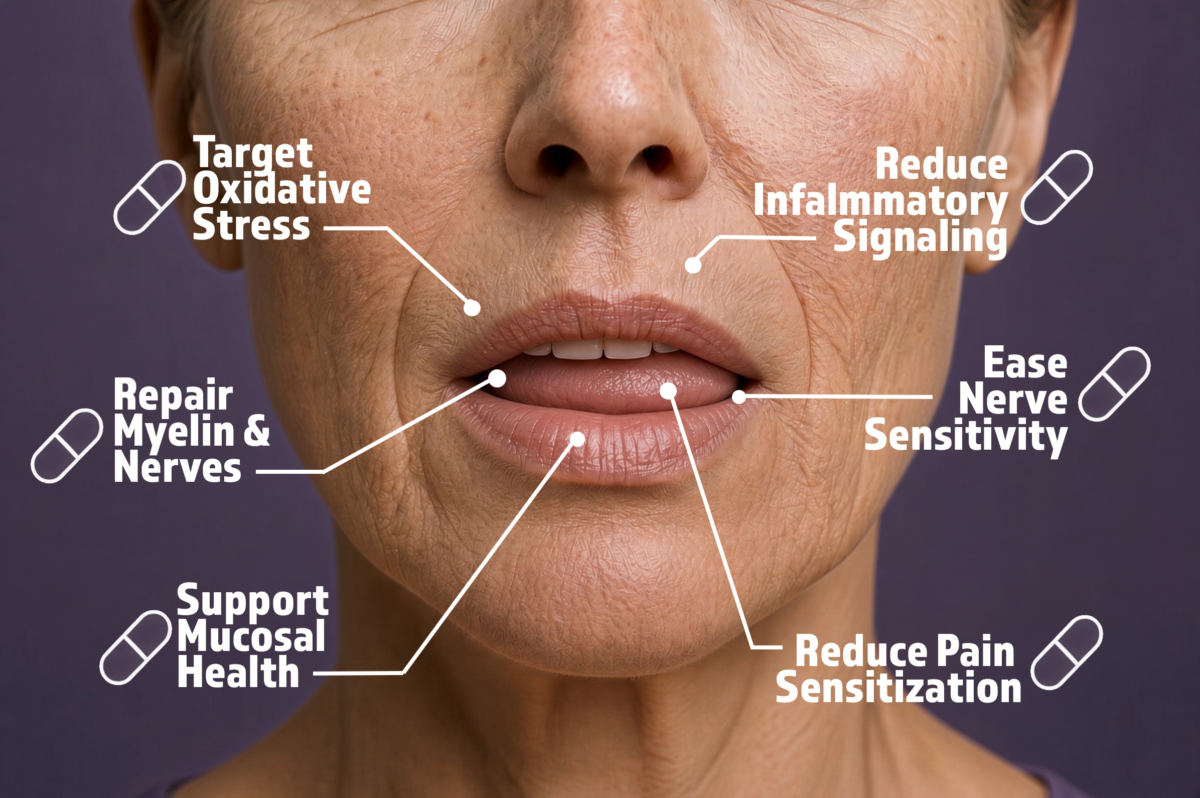
B Vitamins —Repairs myelin and restores nerve function — corrects the nutritional roots of secondary BMS
DHEA — Restores hormonal precursors that support oral mucosal health, nerve sensitivity, and anti-inflammatory signaling
Pregnenolone — Raises allopregnanolone (the brain’s natural analgesic), supports myelination, and reduces central pain sensitization
Zinc — Restores taste perception, supports mucosal healing, and calms the low-grade inflammation that aggravates nerve signaling
Think of it this way: ALA and B vitamins address the nerve damage itself. DHEA and pregnenolone address the hormonal environment that made the nerves vulnerable in the first place. Zinc supports the mucosal tissue and taste system that bears the brunt of the burning day-to-day. Used together, thoughtfully and under guidance, they cover burning mouth syndrome from multiple angles.
This article is for public education only and does not constitute medical advice. Supplements can interact with medications and are not suitable for everyone. Always consult a qualified healthcare professional before starting any new supplement, especially if you have existing health conditions or take prescription medications.
Target Oxidative Nerve Damage
Repair Myelin
Restore Nerve Function
Support Mucosal Health
Calm Inflammatory Signaling
Ease Nerve Sensitivity
Reduce Pain Sensitization
Download Dr. Sklar’s Free Ebook


Hope for Burning Mouth, the world’s first and only online course for sufferers of Burning Mouth Syndrome is now available. It was created by specialist Dr. Susan Sklar and based on her actual experience with Burning Mouth patients.
What You Will Get In The Course
- Lifetime access to your course portal
- A Virtual “Tool Kit” covering all aspects of Burning Mouth Syndrome
- Course work developed by a Burning Mouth specialist
- Seven Modules
- Sixty-two Lessons
- Self-Assessments
- Quizzes
- Homework
- 15% Discount on BMS Advanced Support
- An additional future module on new treatments for Burning Mouth Syndrome